Title IX Complaint Process
Gender Discrimination/Sexual Misconduct Complaint Process
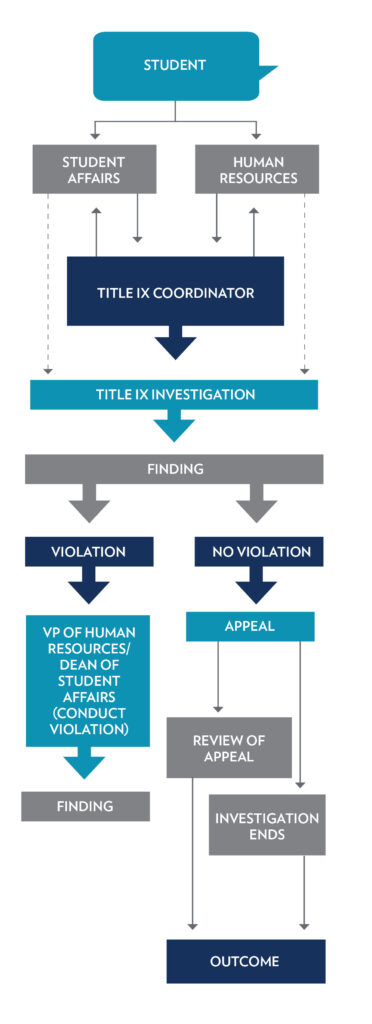
Step 1: Complaint
The student may submit an alleged gender discrimination/sexual misconduct violation to his or her Office of Student Affairs or Cody Thompson, Director of Safety and Compliance, Title IX Compliance Officer
Phone Number: 740.699.3924
E-mail: cthompson@belmontcollege.edu.
Step 2: Investigation
Cody Thompson, Director of Safety and Compliance, Title IX Compliance Officer in partnership with the Office of Student Affairs will investigate the allegation.
No Violation has occurred, and the investigation will belong solely to the Office of Student Affairs to determine if a conduct violation has occurred. The Title IX Coordinator ensures that the Title IX investigation ends, and the Student Code of Conduct process begins.
Violation has occurred, and the Title IX Coordinator and Office of Student Affairs shall prepare a written report that includes a statement of factual findings based upon the information and evidence provided by the complainant, respondent, and any witnesses involved.
Step 3: Findings
The complainant and respondent may file an appeal based on 3 criteria: 1) there was an error in the investigation; 2) relevant material/new evidence/information not previously available at the time of the hearing have been discovered; and 3) sanctions based on evidence of information/failed to consider a piece of evidence.
The complainant or accused has 7 calendar days to appeal this decision in writing from the date the note is sent.
Step 4: Appeals
If granted an appeal the VP of Academic & Student Affairs and the VP of Human Resources conducts the appeal process. They will:
- Uphold the decision of the Title IX Coordinator, and therefore, the matter will be considered final and binding upon all.
- Overturn the decision of the Title IX Coordinator and return it back to the Title IX Coordinator to re-open the case.
Step 5: Outcome
The complainant and respondent will be notified of the outcome via email and certified mail.
The Title IX Coordinator and Office of Student Affairs will act to remedy the effects, enforce outcomes and reassess duties to warn based on the final outcome.